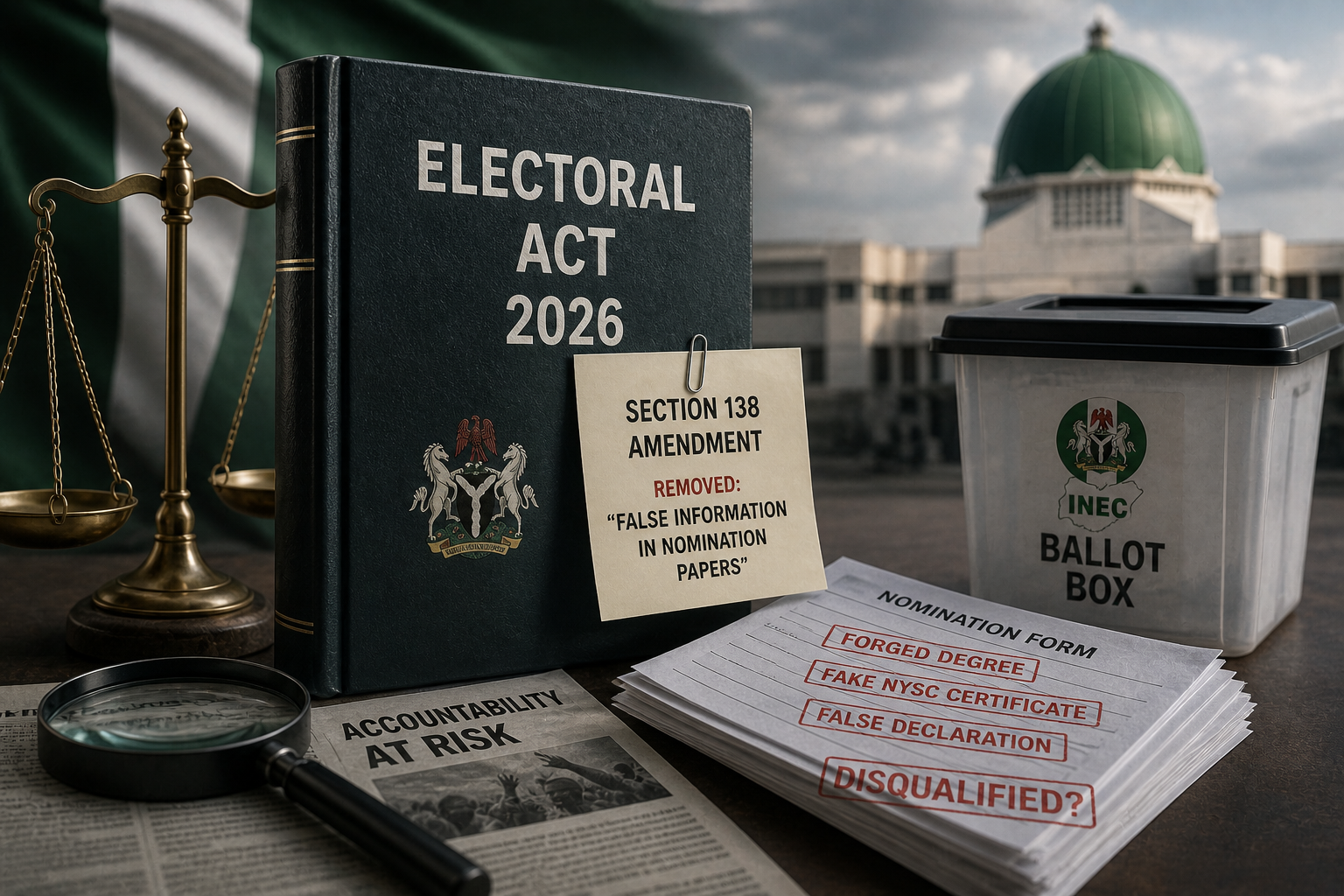

In the wake of the Electoral Act 2026, most of the chatter has been about electronic transmission of results, and rightly so. Civil society groups warned that giving officials discretion over e-transmission could re-open vulnerabilities at the collation stage.
But there’s a quieter change in the same law that hasn’t had nearly as much attention, and it matters just as much.
During its clause-by-clause review in early 2026, the Nigerian Senate altered Section 138. Under the new wording, a court may only overturn an election if either:
- The election was invalid because of corrupt practices or serious non-compliance with the Act, or
- The declared winner did not actually get the majority of lawful votes.
What’s missing is the old, direct basis for challenging an election when a candidate has submitted false documents in their nomination papers.
Before this change, the Electoral Act 2022 made it possible to bring an election petition based on false information in a candidate’s nomination form. In plain terms: if someone lied about their qualifications or handed in forged papers to get on the ballot, that could be challenged after the vote, and the court could set the result aside.
That rule reflected a basic truth: winning votes does not remove the need to be qualified to hold office.
This mattered because Nigeria’s political record shows how often candidates turn up with suspicious documents.
- In 1999, Salisu Buhari resigned as Speaker after admitting he had lied about his age and submitted a forged degree from the University of Toronto and a fake National Youth Service Corps certificate. (Punch Newspapers, 2024; Vanguard, 2025)
- In 2018, Kemi Adeosun stepped down after investigations showed the NYSC exemption she presented during her appointment was not genuine. (Punch Newspapers, 2024)
- More recently, reporting into Uche Nnaji raised questions about documents said to be from the University of Nigeria, Nsukka and the NYSC. (Premium Times, 2024)
- And public disputes over academic claims by Dino Melaye involved checks with Ahmadu Bello University and Harvard University. (Punch Newspapers, 2024)
These problems weren’t revealed by the candidates. They showed up because people and institutions were able to check the records through journalists, party opponents, tribunals or verification systems. That post-vote route was a backstop: if fake credentials slipped through before the election, courts could still fix the result afterwards.
The amendment narrows that backstop. Disputes about qualifications, forged certificates or false declarations are now effectively treated as pre-election problems. That usually pushes them into intra-party conflicts during nominations, not into public court challenges after the vote. And party processes often lack the will or resources to police their own winners.
This change comes against a broader background of weak public oversight. One recent example involves parliamentary scrutiny of revenue accounting within the Nigerian National Petroleum Company Limited, where oversight debates have raised questions about over ₦210 trillion in unremitted or disputed revenues linked to the company’s financial records, a reminder that irregularities become harder to detect once institutional checks narrow.
Research backs this up. A legal review of electoral fraud in Nigeria finds that irregularities happen at every stage – in candidate selection, on polling day, during collation, and in post-election litigation, and that these problems have eroded public trust in election outcomes. The study also notes how politics increasingly becomes a “do-or-die” affair, which raises the incentive to manipulate the process. Dada 2021
Put simply: the law removes clear routes to challenge fraudulent candidates after or during elections, therefore the system loses an important institutional tool for screening for accountability, a crucial measure and muscle for maintaining positive ideals in our society and keeping disproportionate tendencies in check.
Hence the responsibility to spot fraud entirely shifts to earlier pre-election processes to party organs who are often reluctant to act due to their own personal investment in the aspiration for power, consequently heightening the risk that people who win office by misrepresenting themselves will remain in power.
Democratic Elections determine who exercises public authority, but they also depend on confidence that those seeking that authority meet the standards required to hold it. Electoral law therefore functions not only as a mechanism for counting votes but as a framework for verifying the legitimacy of the candidates themselves. The question for voters, civil society and the courts is straightforward: If the law no longer provides a way to expose falsified candidacies after an election, what remains to protect the integrity of our public offices?
Written by,
Taiwo Anuoluwapo.
Communications Associate